If you’re considering laser eye surgery to reduce or eliminate your dependence on glasses or contact lenses, you’ve probably come across two popular options: SMILE and LASIK. Both procedures are safe, effective, and designed to correct refractive errors such as myopia (nearsightedness) and astigmatism, but they differ in technique, recovery, and suitability.
At Custom Vision Eye Care, we help patients choose the most appropriate vision correction procedure through comprehensive eye examinations and personalized treatment planning. In this guide, we’ll compare SMILE vs LASIK to help you make an informed decision.
What Is Laser Eye Surgery?
Laser eye surgery is an advanced vision correction procedure that reshapes the cornea, allowing light to focus correctly on the retina. This improves vision and reduces the need for glasses or contact lenses.
The two most commonly performed laser vision correction procedures are:
LASIK (Laser-Assisted In Situ Keratomileusis)
SMILE (Small Incision Lenticule Extraction)
Both offer excellent outcomes when performed on suitable candidates.
What Is SMILE Eye Surgery?
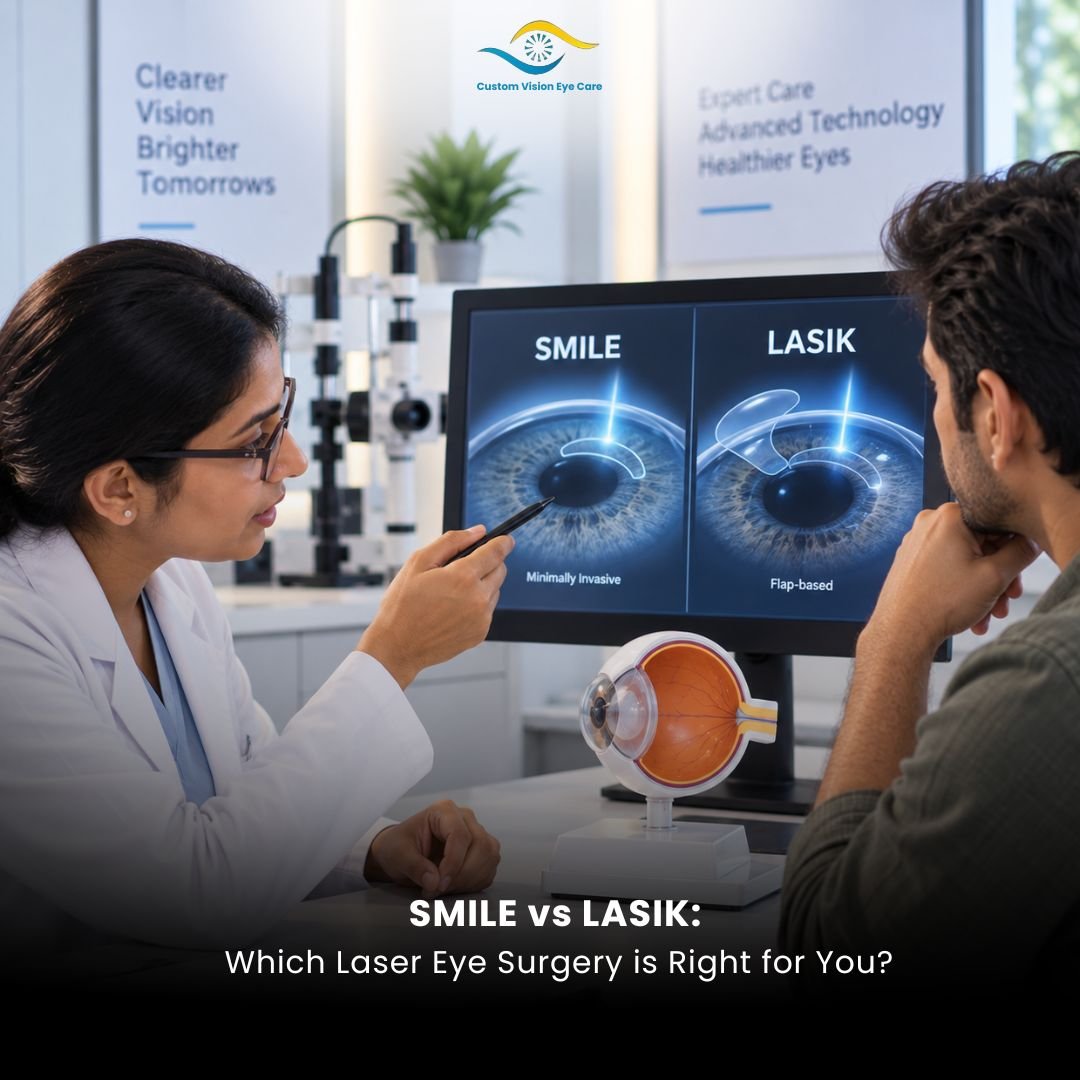
SMILE (Small Incision Lenticule Extraction) is a minimally invasive laser eye surgery that corrects myopia and myopic astigmatism. During the procedure, a femtosecond laser creates a tiny lens-shaped piece of tissue (lenticule) within the cornea. The surgeon removes this lenticule through a small incision, reshaping the cornea without creating a flap.
Advantages of SMILE
Minimally invasive procedure
No corneal flap
Small incision (approximately 2–4 mm)
Reduced risk of flap-related complications
Less disruption to corneal nerves
Lower likelihood of postoperative dry eye symptoms
Faster return to normal activities for many patients
What Is LASIK Eye Surgery?
LASIK is one of the most widely performed laser vision correction procedures. A thin corneal flap is created using either a femtosecond laser or a microkeratome. The underlying corneal tissue is then reshaped with an excimer laser before repositioning the flap.
Advantages of LASIK
Proven track record with millions of successful procedures worldwide
Excellent visual outcomes
Rapid vision improvement
Effective for myopia, hyperopia (farsightedness), and astigmatism
Minimal discomfort during the procedure
Which Procedure Offers Faster Recovery?
Both procedures have relatively short recovery periods.
Recovery After SMILE
Mild discomfort for the first 24 hours
Vision improves over the next few days
Most patients resume daily activities within a few days
Follow-up visits ensure proper healing
Recovery After LASIK
Vision often improves within 24 hours
Most patients return to work within one or two days
Temporary dryness or glare may occur during recovery
Recovery experiences vary depending on the individual and your ophthalmologist’s recommendations.
Who Is a Good Candidate for SMILE?
SMILE may be suitable if you:
Are over 18 years old
Have stable vision
Have myopia or myopic astigmatism
Have healthy corneas
Prefer a flap-free procedure
Lead an active lifestyle or participate in contact sports
A comprehensive eye examination is necessary to determine your eligibility.
Who Is a Good Candidate for LASIK?
LASIK may be recommended if you:
Are at least 18 years old
Have stable prescription numbers
Have sufficient corneal thickness
Have healthy eyes
Need correction for myopia, hyperopia, or astigmatism
Not everyone is a suitable candidate. Your eye specialist will recommend the best procedure based on your eye health and vision goals.
Is SMILE Better Than LASIK?
There is no universal “best” procedure.
SMILE may be preferred for patients with:
Dry eye concerns
Active lifestyles
Contact sports participation
Myopia and myopic astigmatism
LASIK remains an excellent option for many patients, especially those requiring treatment for hyperopia or a wider range of refractive errors.
The right choice depends on factors such as:
Corneal thickness
Eye health
Prescription
Lifestyle
Occupational requirements
Surgeon evaluation
Risks and Safety
Both SMILE and LASIK have high success rates when performed by experienced ophthalmologists.
Potential temporary side effects include:
Dry eyes
Light sensitivity
Glare or halos
Mild discomfort
Fluctuating vision during healing
Following your surgeon’s postoperative instructions helps support a smooth recovery.
Why Choose Custom Vision Eye Care for Laser Eye Surgery?
Choosing the right eye care provider is just as important as choosing the right procedure.
Why Patients Trust Us
Experienced ophthalmologists
Advanced laser technology
Comprehensive eye evaluations
Personalized treatment recommendations
Modern diagnostic equipment
Patient-centered care
Detailed pre- and post-operative guidance
Whether you’re considering SMILE or LASIK, our team is committed to helping you achieve clear, comfortable vision.
Book Your Laser Eye Surgery Consultation
If you’re unsure whether SMILE or LASIK is the better option for you, schedule a consultation at Custom Vision Eye Care. Our experienced ophthalmologists will perform a comprehensive eye examination, discuss your lifestyle and vision goals, and recommend the most suitable laser vision correction procedure. Take the first step toward clearer vision – book your consultation today.